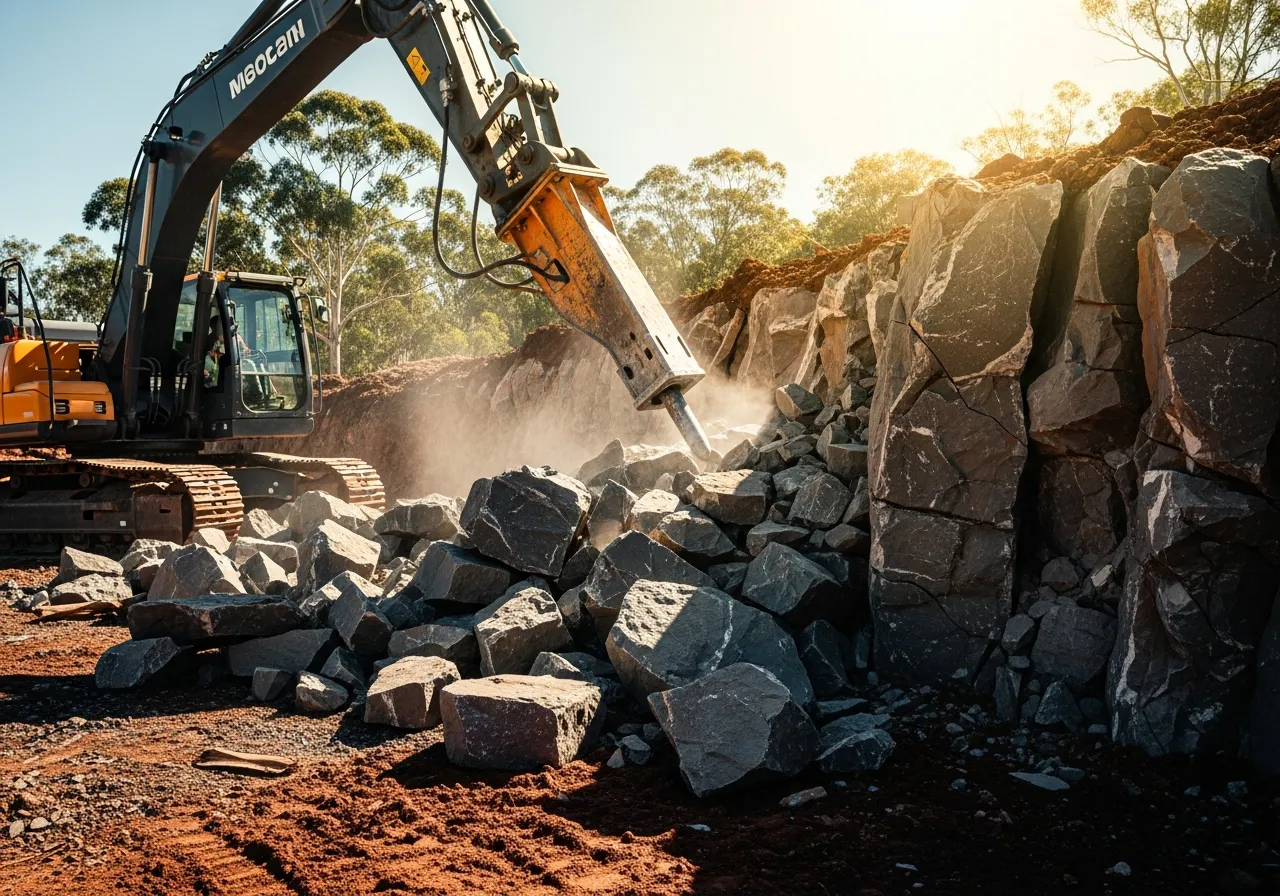
If you've ever talked to a Mudgeeraba neighbour about their pool dig or shed pad, the word "rock" usually comes up. There's a reason. Mudgeeraba sits on basalt-derived ground — the soil profile is rich, deep red clay on top, but underneath that clay you'll often find solid basalt rock at depths anywhere from 500mm to 2m.
That doesn't make Mudgeeraba a bad place to dig — we work here constantly — but it does change the conversation about cost, timeline and equipment. Here's what every Mudgeeraba homeowner and builder should know before commissioning excavation work in 4213.
Where the rock comes from
Mudgeeraba sits at the foot of the Mudgeeraba Ridge and shares geology with neighbouring Tallai, Worongary and parts of Bonogin. The whole area was formed by ancient volcanic activity — basalt flows that weathered down over millions of years into the clay-rich soil you see at the surface. Dig deep enough and you hit the parent rock.
The depth varies massively block by block — sometimes street by street. The lower flatter parts of Mudgeeraba (off Old Coach Road, around Mudgeeraba Creek) tend to have deeper soil profiles. The elevated areas (Bonogin Road, Worongary Road, anything climbing the ridge) often have rock within 600mm of the surface.
When you'll definitely hit rock in Mudgeeraba
- Pool excavations on elevated blocks — almost always
- Deep footing excavations for two-storey builds
- Driveway cuts on sloped blocks
- Tank pads and shed pads requiring level cuts into the slope
- Septic/treatment plant excavations
- Retaining wall trench excavations on sloped sites
When you might get away without it
- Topsoil strip and shallow level for sheds (under 300mm depth)
- Vegetation clearing and stump grinding
- Shallow trenching for sub-surface drainage
- Some flat lower-elevation blocks with deeper soil profiles
What rock breaking adds to your cost
Rock breaking is slower work — typically 1/3 the rate of straight excavation in soil — and harder on the equipment, so it carries a higher hourly rate. In Mudgeeraba specifically:
- Standard excavation: $130–$160/hr
- Rock breaking: $160–$220/hr
- Pool dig with rock allowance: $5,500–$7,000 for the excavation, at the top of the range (vs $3,500–$5,000 with little rock), plus around $2,000 for spoil removal
- Footing rock work: usually $1,500–$5,000 over standard footings cost
- Driveway rock cuts: highly variable — get a site visit
We can usually tell at a site visit how much rock is realistic to expect — surface clues like outcrops, neighbour's experience, topography and depth of recent excavations nearby all help us give you a real number. Call John on 0487 193 085.
How to budget for a Mudgeeraba excavation project
Three rules we recommend to every Mudgeeraba client:
- Always get a site visit, never a phone quote. Anyone quoting Mudgeeraba work over the phone is guessing.
- Build a 15-25% rock contingency into your project budget. Better to under-spend than blow your budget mid-dig.
- Ask whether spoil can stay on site. Mudgeeraba basalt makes excellent fill, retaining backfill and rough base — reusing it saves significant money in tip fees.
Working with the right operator matters in Mudgeeraba
Not every Gold Coast excavation contractor likes Mudgeeraba work. Soft-ground operators sometimes underquote, hit rock, then try to walk away from the job or hit you with massive variations. Pick a contractor who works in Mudgeeraba regularly, has the right gear (5T machine with breaker), and gives you a realistic quote upfront.
We work in Mudgeeraba weekly. Rock doesn't scare us — it's just part of the job. If you want a straight answer on what your project will actually cost, call us for a free site visit.