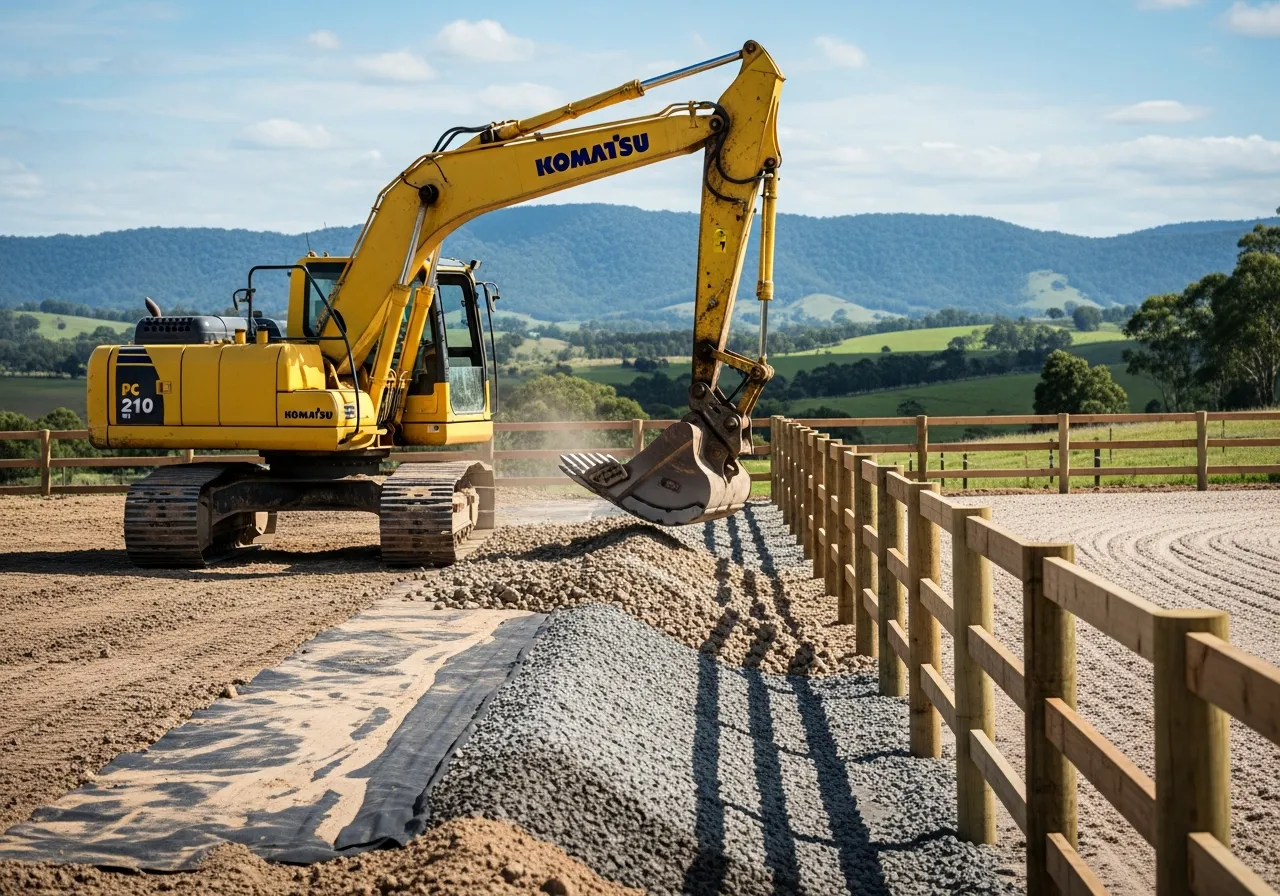
A properly built horse arena is one of the best investments an acreage owner can make — but a badly built one is a constant headache: puddles after every storm, hoof-deep mud in winter, dust in summer, and a surface that bruises horses or trips them. After building dozens of arenas across the Gold Coast hinterland — Tallai, Mudgeeraba, Bonogin, Worongary and beyond — here's how to do it once and do it right.
Choose the right size first
- Standard dressage: 20m × 40m (small) or 20m × 60m (full)
- Show jumping practice: 30m × 60m minimum
- Round yard: 18–20m diameter
- General riding / multi-use: 25m × 50m is a great all-round size
Bigger isn't always better — every extra square metre means more drainage, more base, more surface, more maintenance. Pick the smallest size that lets you do what you actually ride.
Site selection — get this right or pay forever
The single biggest mistake we see on Gold Coast hinterland properties: arenas built in the natural low point of the block because it's flat. That's exactly where every drop of stormwater from the surrounding land funnels. Even with perfect drainage, you're fighting a losing battle.
What we look for in an arena site
- Naturally elevated or capable of being raised above surrounding ground
- Existing soil profile that drains (avoid pure clay if possible)
- Access for a tipper truck and bobcat
- Within reach of a water source for dust suppression
- Setback from house, neighbours, and tree drip-lines
Dig a 600mm test hole during or after rain. If it holds water for more than 24 hours, that's a clay layer telling you drainage will be your biggest cost. We do free site assessments — call 0487 193 085.
The layered build — what goes underneath matters more than the surface
A horse arena is a sandwich. Every layer has a job. Skip one and the whole arena fails.
Layer 1 — Sub-grade (the natural ground)
Strip topsoil and any organic matter back to firm subsoil. Cut the pad to a uniform 1% fall (1m over 100m) in one direction — usually away from the prevailing wet-weather flow. Compact thoroughly with a smooth-drum roller.
Layer 2 — Drainage
Install slotted ag-pipe in a herringbone pattern at the low edges, wrapped in geotextile and bedded in 20mm aggregate. Connect to a soakage pit or stormwater discharge well away from the arena. On heavy clay sites, consider a full sub-surface drainage grid under the entire pad.
Layer 3 — Geotextile separation fabric
Non-negotiable. A heavy-duty woven geotextile between the sub-grade and the base course stops fines pumping up into the base and the base sinking into the subsoil. We use a minimum 200g/m² woven fabric — overlap seams by 300mm.
Layer 4 — Base course (compacted road base)
150–200mm of 20mm road base, laid in two lifts, watered and compacted to 95% standard density. This is the structural floor of the arena — it carries the load and prevents settlement.
Layer 5 — Sub-surface (optional but recommended)
75–100mm of crusher dust or fine screenings, compacted firm. This evens out the base and creates a clean transition to the riding surface.
Layer 6 — Riding surface
100–125mm of arena-grade sand (or sand/fibre/rubber mix — see below). Never compact the riding surface — it should be loose, springy and consistent depth across the whole arena.
Choosing your riding surface
Pure washed silica sand
The classic. Cheap, reliable, easy to maintain. Use a sub-angular washed silica sand — round beach sand is too unstable and packs hard. Downsides: needs regular watering for dust, can pack down without harrowing, expensive if you need a lot.
Sand + fibre
Adding chopped synthetic fibre (typically 1–2% by volume) hugely improves cushion and reduces dust. The fibre binds the sand particles together, holds water better, and gives a much more consistent feel. Significantly more expensive but lasts longer.
Sand + rubber
Recycled rubber crumb mixed through sand adds shock absorption — great for jumping arenas. Watch for cheap rubber with metal contamination; specify clean, fines-free crumb.
Full synthetic (waxed or engineered)
Top-end dressage and Olympic-spec arenas. Beautiful surface, very low maintenance, very high cost. Generally overkill for private acreage arenas.
What it actually costs on the Gold Coast (2026)
- Basic 20m × 40m sand arena, gentle site: $18,000 – $28,000
- Standard 20m × 60m with full drainage, moderate site: $32,000 – $48,000
- Premium 30m × 60m with sand/fibre surface, difficult site: $55,000 – $85,000
- Add fencing, lighting, kickboards, sprinklers as required
The biggest cost variables are the volume of cut/fill required to level the pad, the amount of drainage needed (huge variation between sandy hinterland sites and heavy clay), and the riding surface chosen.
Common mistakes we get called in to fix
- No geotextile between base and sub-grade — base sinks into clay within 18 months
- Riding surface laid directly on compacted earth without proper base — turns to mud in winter
- Inadequate drainage — water sits, base softens, arena becomes unusable for half the year
- Cheap round sand that packs hard — concussive, tough on horse legs
- No fall on the pad — even great drainage can't help if water has nowhere to go
- Riding surface too deep (>150mm) — heavy going, tires horses, hard to maintain
Maintenance — what owners need to do
- Harrow or drag the surface weekly during regular use
- Water for dust suppression in dry months (a simple sprinkler line is worth installing during build)
- Top up surface sand annually as it works down into the base
- Clear ag-pipe outlets every 6 months
- Check fall and edges yearly — top up any low spots
A well-built arena should give 15–20 years of reliable service with this level of maintenance. A poorly built one will be costing you in repairs from year two.
We've built arenas across the Gold Coast hinterland — Tallai, Mudgeeraba, Bonogin, Worongary, Springbrook, Currumbin Valley. Free site visit, fixed-price quote, owner-operated. Call John on 0487 193 085.